
Investors Didn’t Want Data Centers. But They’re Investing in This Data Center Company.
%201.webp)
Illustrative 15 MW SkyMod deployment · Source: BluSky AI
"Not in my neighborhood."
From Amsterdam to Ypsilanti, people around the world are saying “no” to data centers in their hometowns. American communities blocked or delayed 75 data center projects worth roughly $130 billion in the first quarter of 2026 alone1.
They don’t want acres of windowless buildings that draw on the town’s power and water.
Plenty of investors have felt the same way about investing in data center companies.
And yet, AI investment keeps climbing. More than $1 trillion has already gone into AI infrastructure worldwide, and Goldman Sachs projects AI will need 3X the data center capacity that exists today just to keep up.
Investors assume they’re left with two bad options. They can invest in what they hate, or sit out the biggest infrastructure buildout in a generation.
But they’re finding a third option right now:
Invest in a data center company that doesn’t drain the town’s resources to do its job.
Hear from an investor on why they chose to back BluSky AI:
Fundamental Research Corp. (FRC), a research firm paid by BluSky AI, has given BluSky a buy rating and a fair value estimate of $15.81 per share, nearly three times the company's current offering price. And that offering price is fixed in the company's filings at $5.50, regardless of where the stock trades on any given day.
Become a Shareholder
Data Centers That Use Less Power, Less Land, and 99.5% Less Water
SkyMod sites run 4 to 50 MW. Traditional hyperscale sites run 500 MW and up.
Bigger campuses also use a lot of the town's water. Not BluSky AI.
Their system uses closed-loop liquid cooling. The same water runs through pipes, cools the machines, gets cooled back down, and goes around again. You fill it once, like the radiator in your car, and top it off now and then. This type of mechanism has been reported to use about 22,000 gallons a day, where the old spray-and-evaporate method would have used about 5 million2.
Less power drawn, less land taken, less water gone. That is what a data center looks like when it is built to be approved instead of argued over.
BluSky AI is building them now, and you can invest.
Become a Shareholder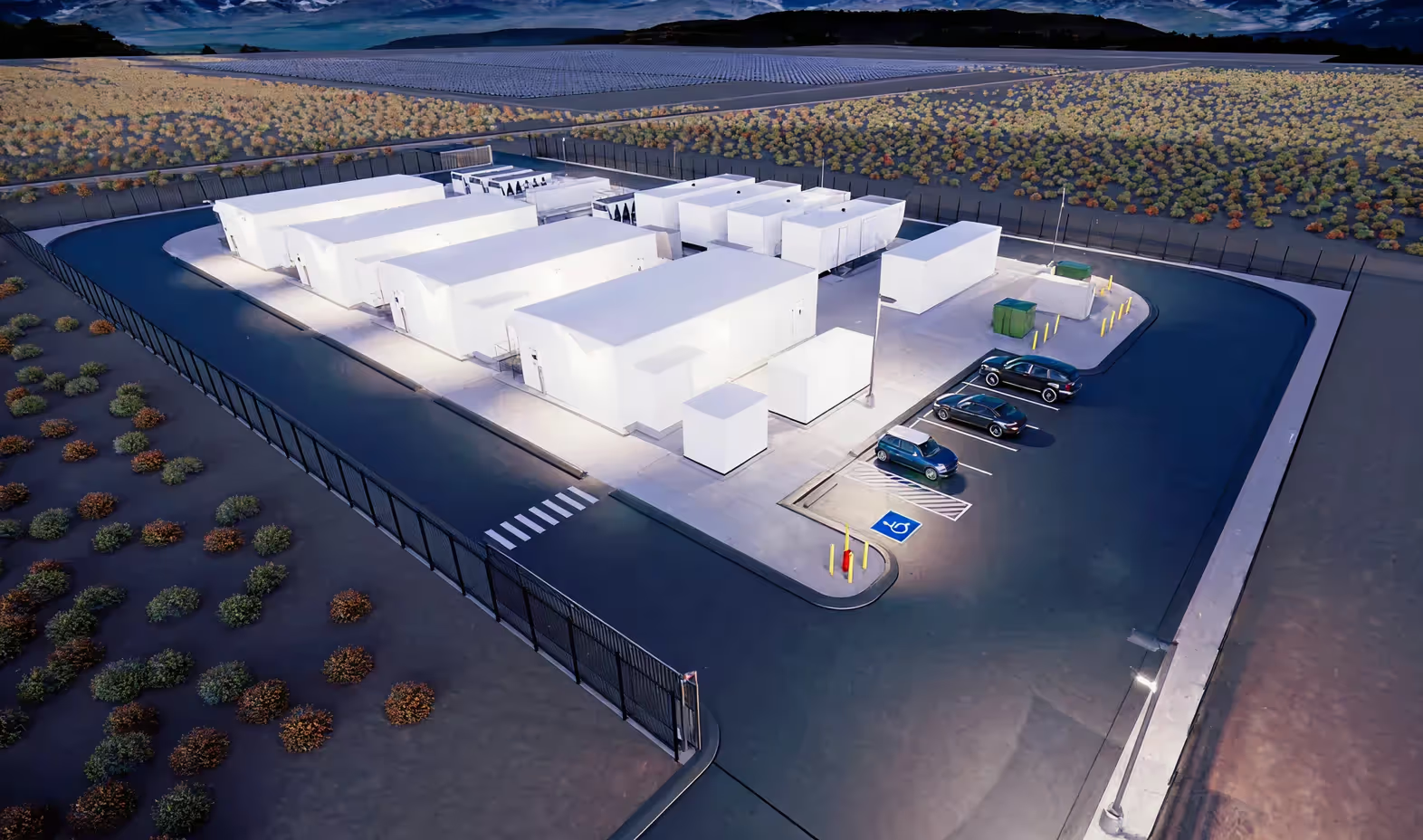
The Company Behind 3X Faster Data Center Builds
Their facilities are called SkyMod™ AI Factories.
Inside them: NVIDIA GPU technology, the same class of processor the entire AI industry is competing for.
That one design decision, factory-built instead of field-built, is a timely breakthrough for a number of reasons:
They don’t have to wait for electricians.
Microsoft's president named the electrician shortage the number one problem slowing U.S. data center expansion. Electrical work accounts for 45% to 70% of data center construction costs, and a single site can require up to 1,500 workers at peak. Prefabrication moves most of that labor from 20 separate job sites to one factory3.
They don’t have to generate power from scratch.
GE Vernova's gas turbine backlog hit 44 GW in Q1 2026. Lead times run about three years, and slots are effectively booked through 2029. BluSky AI's approach is to place SkyMod units where power already exists rather than build generation from scratch4.
They don’t drain as much power and use little to no water.
SkyMod units are compact, use little to no water, and are designed for powered land rather than sprawling new campuses.
BluSky AI is not the only company that noticed this need.
Become a ShareholderThe difference: for those companies, modular is a tactic. For BluSky AI, it is the whole company.
The modular data center market is projected to reach $70 billion by 2030, up from $29 billion in 20245.
What BluSky AI Plans to Sell: Compute, by the Hour
BluSky AI is building toward what the industry calls a neocloud, a cloud provider built specifically for AI and machine learning rather than adapted from general-purpose hosting.
BluSky AI SkyMod
vs
Traditional Data Center
GPU-as-a-Service.
High-performance GPU capacity rented through usage-based pricing.
AI-optimized design.
Every SkyMod is engineered for power efficiency, cooling, and network speed.
Transparent pricing.
Per-GPU rates that include compute, networking, and storage.
Scalable deployment.
Modular units are designed to expand in increments as demand rises.
Enterprise partnerships.
Collaborations with organizations that need dedicated AI-ready infrastructure.
Note which direction the revenue line points. GPU rental rates rose from roughly $1.85 per hour in late 2025 to about $2.40 by March 2026, a nearly 30% increase. Data center rents rose across every size tier in the first half of 2026. In most technology markets, scale drives prices down. In AI computing, scarcity is pushing them up6.
.webp)
Shipped as 50’ modules by semi, direct to site
.webp)
Illustrative 4.5 MW SkyMod facility
Source: BluSky AI, via FRC equity research.
20+ Locations Planned. 200+ MW Targeted.
The current portfolio spans Utah, Colorado, Kansas, Oklahoma, Missouri, Texas, and Tennessee. It includes a 50 MW site in central Utah, a 50 MW site in north-central Missouri, and a 45 MW site in northeast Tennessee.
.webp)
20+
modular locations planned across the U.S.
200+ MW
of planned compute capacity
10+
SkyMod sites announced to date
Months, not years
targeted deployment per unit
All site and capacity figures reflect current plans and negotiated positions, not operating facilities.
Why Investors Are Backing BluSky AI Now
$5.50
Fixed offering price per share
Up to 20%
Bonus shares based on investment amount
BSAI
Already trading on the OTCQB Venture Market
200+ MW
Planned compute capacity across 20+ planned U.S. locations
100X
AI compute demand vs traditional cloud
$7.1T
Projected AI investment by 20307
Become a BluSky AI shareholder at $5.50 per share, with bonus shares of up to 20%.
SOURCES
1. https://www.datacenterdynamics.com/en/analysis/the-ongoing-impact-of-amsterdams-data-center-moratorium/
https://fortune.com/2026/06/21/data-center-backlash-harvard-study-zoning-local-pushback/
https://www.datacenterwatch.org/q1-2026
3. https://www.apollo.com/wealth/insights-news/insights/2026/06/growing-compute-shortage
4. https://fortune.com/2026/03/02/ai-data-centers-electrician-shortage-gen-z-training-careers/
DISCLAIMER:
The Regulation A Offering is currently priced at $5.50. New shares are issued within 30 days on average. There are no additional fees for purchasing Reg A Shares. See investment risk disclosures in the Form 1-A and further below.
BluSky AI Inc. has paid Fundamental Research Corp a fee for research coverage and distribution of reports. Fees ranging between $20,000 and $30,000 will be paid to FRC by BluSky AI to commission this report, research coverage, and distribution of reports. FRC states that this fee creates a potential conflict of interest which readers should consider. FRC and its analysts do not own any shares of BluSky AI and do not have any investment banking business with the company.